Labels

Wednesday, August 21, 2019

2008 Ford Escape Driver's Side CV Joint Replacement (how to)


-->
            Last year as our family was preparing to move from Galena to Unalakleet, we decided it did not make financial sense to ship our beloved 1997 extended cab F-150 out to the coast as it would not fit on a freight plane and shipping by barge was cost prohibitive.  So, we began shopping for a vehicle that met the less than 17’ long requirement of Everts Air Cargo.
            We located a 2008 Ford, 6-cylinder, 4-wheel-drive Escape located in Fairbanks.  An F-150 it is not, but it would be enough to launch our small river boat and should handle the snow and ice of Unalakleet winters okay.  Our college-aged daughter agreed to take it for a test ride and I gave her a list of things to look out for.  One of those things was any noise in the front-end. 
            Upon test driving it, my daughter noted and pointed out a front-end noise to the seller. 
            “Oh, that is just road noise…” the seller claimed.
            I was skeptical, but the car met our needs… it was four-wheel drive, would fit on a plane, etc.  We moved forward with the purchase knowing that something would have to be done to the front-end.
            Fast forward through a year of driving with a very noticeable, very not road noise clatter coming from the driver’s side front wheel.  It was definitely the sound of a faulty CV joint, but as a public-school administrator responsible for sports on the weekend, extra time was not something I had a lot of.  It would have to hold and did until I could get to it.
            I ordered a CV joint from Rock Auto and then waited for a comfortable day (not blowing 20 mph, not freezing, relatively bug free).  The replacement was pretty straight forward.
2008 Ford Escape 6-cylinder, 4-wheel-drive

            I parked the car on a mostly flat spot, assured it was in park, set the brake, blocked the wheels and loosened the lugs on the wheel.  An Escape is a unibody car and so it has some very specific jacking points.  According to the owner’s manual, this is below the bolt that attaches the control arm to the body reinforcement under the car.  I jacked the car and placed a jack stand below the body reinforcement (I have a major fear of having a car fall on me after watching the family minivan hop off a jack in my dad’s garage as a kid).
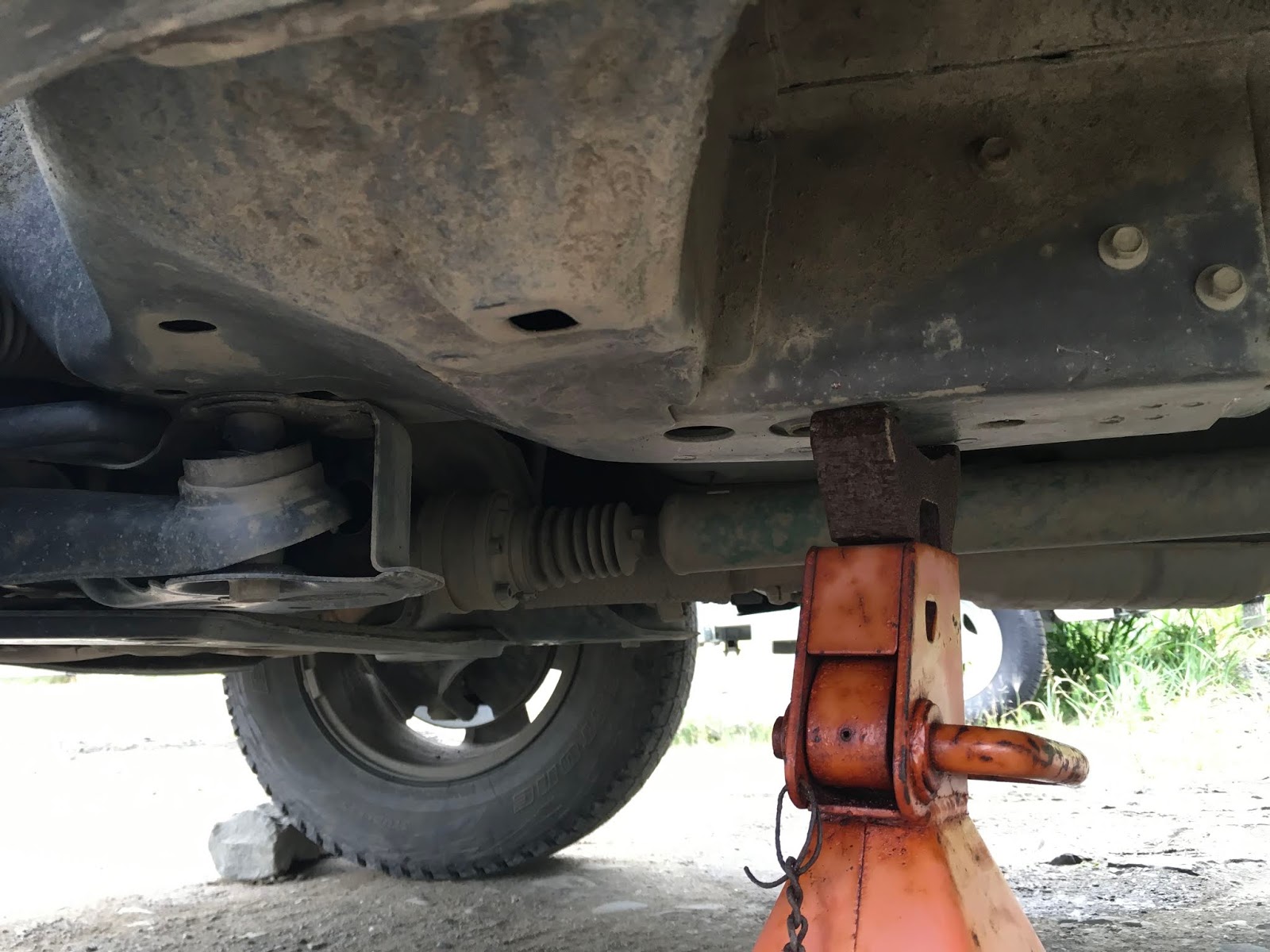
Jack stand under body reinforcement

            With the car on the jack stand, I pulled the front wheel.  I am not sure if I really needed it, but I blasted each fastener that was going to be removed with a healthy dose of WD-40 just to make removal easier. 

            The brake caliper came off first by removing the two 18mm bolts (I am a little sad that I own a Ford that requires the use of metric sockets… I believe my F-150 was all standards).  I had a duck decoy sitting on the porch (doesn’t everyone) that I cut the decoy line off of and looped the line around part of the caliper and up around a coil of suspension spring.  It is not wise to leave the caliper suspended from the brake line, and this also got the part up out of the way.


Top Caliper bolt can be seen in the center.  The bottom bolt is straight down from it and the same size.
A little decoy weight line was enough to suspend the brake and caliper from the suspension spring.

            Following the caliper, the shock tower is disconnected from the hub assembly.  It is attached through another two 18mm bolts, but these have nuts holding them and so require a wrench on both sides.  Since these were blasted by WD-40 earlier, they came free with a light grunt and then some wiggling to relieve tension on the assembly.
            The outer tie end must be removed from the assembly in order to allow enough freedom of movement for the old CV joint to slide out as well as the new to slide in upon reassembly.  Again, this is an 18mm, but requires a deep well socket to access the nut.  Once the nut is free, a firm tap against the housing where it is attached to the wheel will loosen it enough to give a careful tap to the end of fastener itself.  I realize that the use of hammer and careful seems oxymoronic, but I didn’t want to distort the fastener making it impossible to put back together.  It is my understanding that there are pullers available at parts stores for this job, but considering I had a tough time finding WD-40 at the two stores in Unalakleet, I didn’t bother asking about a puller.
            The wheel nut comes off next, and since I have an electric impact, I did not bother to break it free on the ground before pulling the tire off and jacking the car up.  I was surprised to find that there was no cotter pin holding a castle nut, but it was more of a nut with an integrated washer… it kept the wheel on for the first 80,000 miles, I guess it’ll have to do until I have to pull it apart again (the new CV joint came with a new nut).  Hopefully that won’t be for quite a few more pothole filled miles.
            There is a sensor attached to the wheel assembly that I was not going to take off, but found was necessary when trying to force the CV joint out of the hub.  The wire would not allow enough freedom of movement and so it had to come off too.  In moving from Galena to Unalakleet, I honestly don’t know where my socket set is with the tiny sockets and so I can’t quote a size for this one that held the sensor in.  I grabbed ahold of it with a pair of vise grips (one size fits all) and removed the bolt that way.  This is probably not the time or place for a rant about sensors and idiot lights, and so I’ll refrain.  Let’s just say my first thought was to cut it, but it came out and went back in just fine.
            At this point, the old CV joint is ready to remove and some pressure applied with just my hands and some wiggling on the lower control arm allowed me to pretty easily push the CV joint free.  I was feeling pretty cocky.  I had been dreading this job for about a year as I walked by the part stacked in our entry corner multiple times a day.  But… here I was a couple of minutes from having the old one out and ready to put the new one in.  I placed a drain pan under the transmission and CV joint in case any transmission fluid should leak out.

            I have relatively large hands and there is really nothing relatively large in an Escape.  I have looked at newer ones under the hood, and it is only getting more crowded in there.  With this in mind, it was difficult for me to get both hands on the CV joint where it enters the transmission.  It is pretty much held in place by a little clip (look at your new replacement if you are doing this job), and should just take a good popping tug to bring free.  There is not much room in there to place a large screw driver and so I grabbed as close as I could to the transmission and pulled.  It was at this point that the little voice in my head that often shows up sometime during a project spoke up.
            “What if you can’t get the old one out?”
            I grabbed the end of the CV joint… don’t do this if you are doing this same job, and I gave a firm tug.  Something gave, but it wasn’t the CV joint coming out of the transmission.  The boot closest to the transmission stretched out and something inside of it stretched with it.  Whatever it was was not willing to go back the way it came and the little voice spoke up again.
            “Huh…”
            The point of no return.  I found a space to place a large flathead screw driver between the transmission and the CV joint where the two join, did some careful popping motions with the screw driver, did some wiggling pulling with my free hand, and the old joint came free.  It is my understanding, now that the job is done, that there is a special tool that can help with this job.  It is a type of fork that slides over the joint between the CV joint and the transmission and is then struck with a hammer.  Evidently, it is not necessary.
            Everything goes back together in reverse order.  I was extremely careful to keep the two ends of the CV joint clean as not to introduce any foreign matter to the works.  The new joint enters the transmission and is pushed firmly into place.  A gentle tug assures that the clip is doing its job.
New CV Joint in Place

            The only hiccup that may arise in putting everything back together is the break caliper plunger being extended and not allowing the brakes to slide over the rotor.  I had this happen while replacing the hub assemblies on our 97 F-150.  I used a C-clamp to press the plunger back in and it allowed me to slide the caliper back on.  I did not have that problem this time, but if someone can learn from difficulties I have had, all the better.
            After getting everything back together, a quick test drive confirmed that the rattle, at least that rattle, was gone.  My ears are convinced that something else is rattling in there now, but thankfully not as pronounced… maybe the other side?

Saturday, August 17, 2019

Over the River


-->
          We were happily picking low bush cranberries by the bucketful when the clouds began enveloping Army Hill.  I stood and watched as my view went from the village of Unalakleet and blue ocean beyond to being just a sea of gray, moist clouds.  A fall mist began to coat my hands.
            A quick glance over my shoulder to the east revealed that it was not just a local phenomenon.  A current of gray was pushing its way into the Unalakleet River valley and sealing off our route home.  I bent back over and continued filling my bucket.  At least I had some control of the berries plopping into it.
            As a low-time, VFR bush pilot, I was very much at the mercy of the weather.  Myra and I had flown to Unalakleet from Galena in our small Piper Tripacer to enjoy a couple days of berry picking and visiting with family during the Labor Day weekend.  These clouds meant it would be more than a couple of days, and what I knew about weather on the coast began the wheels spinning of how this weather could decide to hang here for over a week, maybe more.
            Back at Gram’s house, Myra packed the deep red berries into quart-sized Ziploc freezer bags.
            “I’m going to check weather,” I said as I put on a dry sweat-shirt.  “I’ll be right back.”
            The Hageland terminal would have internet, a computer to check the aviation weather site, and pilots to strategize with.  Ferno and Jim were both behind the counter when I walked in.
            “I don’t think you’re going anywhere today,” Jim said from over my shoulder as I looked at the computer screen.  “Might as well just stay inside until this blows over a little.” 
            The common saying in Unalakleet was, “well, the weather is finally bad enough for Jim to fly” and he was recommending I stay tied down and go sit on a couch.  Seemed like good advice.
            “We’ll be here tomorrow,” Ferno smiled, “come back and check then.”
            The rain was honest drops now that I was on my way back to the house and didn’t do much to lift my mood.  As a teacher, it is easier to go to work almost dead than to write sub plans.  This holds doubly true when those plans have to be written remotely and emailed back to school.
            “Not going anywhere today,” I proclaimed as I walked through the door.  “Might as well go pick some more berries,” and that is what we did, standing on a hill in the soup.
            The next day proved a little better.  At least the clouds were a shade of light gray, and it wasn’t currently raining.
            “Well, you could fly out and see what the pass looks like at least,” Jim encouraged while we visited at Hageland.  The current conditions were technically VFR, but with Unalakleet sitting pretty much at sea level and the valley gradually sloping up into the Nulato hills and a 1500 foot ridge just before Kaltag and the entrance to the interior, things could prove interesting.  We topped off the wing tanks (a little over three and a half hours of fuel for a little over one hour flight) just to be sure we had plenty in case of rerouting.
            Myra and I slid into our seats, fired up the plane took off from Unalakleet’s 1900 foot runway 08, climbed to around a thousand feet with a little room to spare for safely flying below the clouds. 
            The clouds pressed us lower as the valley began rising up toward the pass at Kaltag, a solid sheet of gray just above our heads and completely covering the tops of the Nulato Hills to the south.  When the pass was socked in, those hills sometimes allowed for an escape from the valley and down into the Yukon River basin on the other side.  Not today.  We flew lower and the ground started to come up to meet us.  At Old Woman the clouds were kissing the top of the hill near the shelter cabin, and we decided to turn back before the route behind us closed off.
Time to Turn around (Old Woman in the Clouds)

            “This is dumb,” was my very technical pilot analysis.  “We’re going back.”
            “Sounds like a good idea to me,” came Myra’s voice in my headset.
            Back on the ground and tied down, I typed up lesson plans at the Bering Straits School District’s hangar.  Tomorrow was Tuesday and students would be returning to school after the four-day weekend.  I clicked send on my sub plans and decided to wait until the next day to check the forecast.
            The terminal area forecast (TAF) was predicting a small window.  It would still be overcast, there would still be some rain in the area, but it was saying things would be okay.  The TAF was also saying that the window was only going to be open for a short period, about half a day, before slamming shut with 700-foot overcast ceilings and lower as well as minimal visibility.  The significant weather charts were saying it was going to be that way for the foreseeable future, and because I like to consult all possible sources, I looked at the magic 8 ball that is wunderground (modern weather forecasting is really good, but ten days is a pretty big stretch).
            I walked back into the house, “We’re going to give it a shot,” I told Myra.  “If we want to get back this week, we need to go now.”
            Flight service was optimistic about the route of travel.  Weather cameras were showing Kaltag to be a little low cloud-wise, but the briefer could see all of the hills in the area.
            Myra and I said our good-byes to family for the second day in a row, loaded the plane, topped off our tanks, and fired up the engine.  The local automated weather station was calling 10 miles of visibility, but the fine mist coating the windshield did not agree.  The rain was pretty much just over town though, and once we were airborne, visibility should improve.  We taxied out onto 08 and I pushed the throttle to the firewall, the plane reached rotation speed, and the ground began to fall away.
            The valley was clear of precipitation, and though not high, the ceiling was enough to encourage us to fly on.  We had turned around at Old Woman the day before, but had no problems flying 500 feet above the hill while still remaining clear of clouds.  In the distance, we could see the ridge line marking the entrance to the pass between the valley and Kaltag on the Yukon River side. 
Things were a little better...

            “We can fly up to where the pass opens around that hill,” I said pointing toward the pass, “get around the hill and if it is closed off, turn back.”
            “That will be the plan,” Myra agreed, “we should know at that point if we can make it through or not.”
            As we approached the hill, I throttled back and slowed down to allow more time for decision making and more throttle to give if we needed it.  We made a shallow left banking turn and stretched our necks out to see around to the other side.  Myra held the iPad GPS in her lap and studied the topography of what lay on the other side of the first hill.  I leveled out my wings and banked back right and slid between the hills that were reaching up and into the clouds, their tops around 2500 feet.
            What greeted us on the other side even now robs some of the air from my lungs.  A gray wall of clouds stretched down to the ground and reached up to the ceiling completely closing the pass.  The hills to the left and right silently disappeared from view, and we were completely committed.  I came out of my right bank shoved the throttle in, remained level to gain airspeed, and then headed for the only place I knew didn’t hold a hill: straight ahead and up.  Eyes on my panel, I maintained 90 knots, level wings, and climbed.
            “Tell me we’re over the river,” my voice echoed in my headset a little more firmly than intended.
            “Jason?”
            “We can’t turn around in here, as long as the river is below us, we’ll climb out just fine.  Tell me we’re over the river,” I repeated.
            “We’re over the river.”
            “Keep an eye on the map, keep me over the river, we’ll be fine.”
           
            We were in that cloud for a matter of minutes, but we had both lived through weeks that seemed shorter.  We climbed up and through, and as Myra would say later, it was like a blanket was pulled away.  The clouds began to break, gray light became brighter, and the village of Kaltag could be clearly seen in a hole in the clouds that we promptly dropped through.  Neither of us had ever been happier at seeing the silty water of the Yukon.
            “I think we just discovered a new minimum for the pass,” Myra calmly said, “3000 feet, or we don’t go.”
            I just breathed.
            The ceiling still was nothing to get excited about.  We were greeted into the interior by overcast skies that ended up pushing us just below 1000 feet and showers in the vicinity meant visibility wasn’t unlimited, but once past Kaltag, the ground was flat.  We kept the river in sight, avoided heavy rain showers, and cruised into Galena landing straight onto runway 07.
            The plane was silent after shutting down the engine as we just sat for a couple of minutes.  So many things could have gone wrong.  We have no plans of quitting flying, but we have no desire to be cowboys.  Cowboy bush pilots don’t grow old in Alaska.

Old Woman on a nice day to fly.