Labels

Sunday, September 8, 2019

Politically Incorrect History


           In 1940s Nome, Alaska, a little Eskimo boy ran from his side of the segregated school playground to no-man’s land in the middle and pointed and yelled to a little white boy of about his age on the other side, “Aziuqpaqtutin!”  (You’re a bad boy).
            In return, the little white boy looked at him and yelled, “Ilvituaq.”  (You too).
           
            Sixty years later found me standing in the kitchen of a house in Unalakleet.          
“You’re not a bad guy for a white man,” rolled off of the elder woman’s lips with a smile as she looked up at me.
            Growing up in rural northern Michigan, moving to Alaska, and falling in love with an Inupiaq woman left me in pretty alien territory.
            Before my mind could stop my tongue, “You’re not a bad lady for an Eskimo woman,” rolled off my lips with a smile and we both laughed warmly together.
            And so was the first meeting with the mom of my then girlfriend.
            The daughter and I became closer and so there were many more meetings in the same kitchen.  Her mom and I became closer too.
            “I almost married a white, army man once,” she revealed.  “My mom told me that she wanted to be able to talk with my husband in her language and so I should not marry him.  He was very sad when he went away,” she ended quietly. “I married a Siberian Yupik, and he couldn’t speak the same language anyway,” she smiled remembering.
            “Ellen,” I said, “I would like to marry your daughter.”
            “That would be okay.”
            “I understand in your husband’s culture the young man is supposed to work for his wife’s mother and father for a year,” I said.
            “When we got married,” she answered, “Howard did not work for me since that was not my family’s way.  Since I was a cheap bride, Myra will be too.”
            “May I marry your daughter,” I asked to be sure of her answer.
            “Just don’t move my daughter too far away from me.”

            Present day and there is a little Ellen running around the living room as Grandma Ellen tells her stories, “I don’t know about the little Eskimo boy, but last I knew, the little white boy was still living in Nome.  His wife has died, but he is still there,” Ellen recounts.
Segregation was still the way of the land in Alaska in the 1940s.  Ellen, who lived it refers to it as “the racist times.”  Her cousin Maggie had been on the playground on that day and saw the interaction.
            “There was a half-breed woman and an army guy who went to the theater.  He didn’t know, but they were sitting in the white section,” Ellen continues on the same theme.  “They kicked them out.”
            “Menadelook tried to help during those days,” she emphasizes since names have meanings and she gave a lot of thought to it before naming me after this man, her uncle.  “He built schools, he was a teacher, he helped people.”
            Oral tradition is cyclical and stories are repeated many times to assure they are told correctly, and so Ellen returns to the story she started with.
            “Aziuqpaqtutin!:  You’re a bad boy,” Ellen repeats.  “Ilvituaq: You too… the little Eskimo boy wasn’t expecting that,” she smiles.
             And, I write it down so that, though some cycles should come to an end, this story will continue and the story cycle will go on.

Ellen and Ellen
           

Monday, September 2, 2019

Ellen's First Moose Hunt


-->
Going on a moose hunt

“Ooouurghhh,” I grunted from the edge of a grass lake.
            “I heard that sound,” came the excited yell of the three-year-old working hard to catch up to her dad.
            “That was me,” I loudly whispered (oxymoronic, but everyone has done a loud whisper to a toddler at least once).
            “Oh, are we being quiet?” she yelled again.
            We did not bring her for her hunting skills, her ability to be quiet, or for an extra back to carry out meat should we shoot a moose.  In all honesty, for most of the lakes and through all of the willows, she was carried: a thirty-pound practice round of what it would be like to pack a moose out of the places we carted her in and out of.
            “We’re being quiet,” I leaned over and whispered in a hushed tone now that she was holding on to my leg.
            “Oh,” she whispered, “are we looking for a moose?” excitement in her voice.  “What are we going to do once we find one?” she continued.
            “Well, I was kind of hoping we could convince him to come home with us,” I smiled.
            “So we can eat him?” she laughed.  “We’re going to find a moose and eat him.”
            Even at three she understands where meat comes from and if a person can be considered an avid outdoorswoman and hunter at such a young age, Ellen is one for sure.  After all, she has traveled multiple hours up the Unalakleet River by open river boat in the fall to camp in the wild out of the hope that we might find a moose and convince him to come home with us.
            Just the act of getting all three of us up the river was a feat.  I am not sure who had the harder, more stressful job: Myra driving our sixteen-foot boat through miles of shallow rocky bends or me keeping Ellen inside of that boat.  It felt like I had hooked a big fish and was trying to keep him on the line as I had one finger looped through the webbing of Ellen’s lifejacket for the three hours it took to get from boat launch to campsite.  In the midst of all of the action, there was laughing, yelling, and crying no matter how hard I tried to keep my emotions under control.  Myra was cool at the controls as she read and navigated a part of the river none of us had been in before.
            “Ooouurghhh,” I grunted again.
            Ellen quietly laughed this time as she looked at me out of the corner of her eye.
            “Okay, you call then,” I encouraged.
            “Ooohhhh,” she called.
            We both laughed and I lifted her and walked back to the boat where Myra was waiting.
            “No luck?” Myra asked.
            “No luck,” Ellen answered.
             Back at camp, Myra and I scavenged for wood for a fire.  Small dead spruce branches were abundant and added to a couple of decent-sized dead willow trunks made for a pleasingly warm blaze to dry out socks and take the chill off.  Ellen danced about while Myra and I sat enjoying the quiet, as quiet as nature gets with a three-year-old.
            Ellen made her way to the edge of camp and the trail that headed to the neighbor’s site.
            “Where are you going?” Myra asked.
            “I’m just walking,” was her answer as she faced us and stepped backward stealthily back into the woods.
            “Bub, now is not the time to go visiting,” I said as she continued to inch away, “I bet our neighbors are getting ready for bed.”
            “Do you think their dog is getting ready for bed?” she asked and revealed her motive.
            “I bet their dog already is in bed,” was the quick response from a savvy mom.
            “How about their swing?”
            “ELLEN,” came the chorus of mom and dad together.
            “Fine,” and she made her way back to the fire.
            Bedtime was easier than most nights at home as the fresh air did Ellen in.  She was the first to sleep, but then also the first awake in the morning.
            “Good morning Mom,” was how both parents awoke.
            We held our ground though and pretended to continue to sleep.  The fresh air had done us in as well, and our bodies don’t recover as quickly as hers anymore.
            “I have to poop and pee!” was more than effective at getting me out of bed and effectively started my day.
            Coffee, blueberry buckle, dry clothes, and then back on the river and to the places that we checked that looked moose-y the day before, Ellen still helping to look for a moose to eat, and still being carried in and out.
            At the last spot of the day, I stepped down off of the top of the bank to a clay lump a foot down, Ellen cradled in my right arm.  When my rubber boot made contact with the clay, it just continued going in an upward arc toward heaven and my body continued downward.
            “Agghhhhh!” I landed with the top half of my back over the clay mound and just laid there half groaning for a while.  I really couldn’t say anything else, Ellen still safely in my right arm, wind completely knocked out of my body, and so I took that opportunity to mentally check through the bones in my spine and rib cage.  Seemed like there should be a lot more pain if something was broken, but instead, when I got up, I noticed that my back had pleasantly popped in three or four places and I could stand taller and straighter.
            “Are you okay?” came Myra’s concerned voice.
            “Wow, blue collar chiropractor.  My back feels amazing.  Hurt when I landed, but feels great now,” and we loaded into the boat.
            We packed up camp and headed back to town, the whole return trip pretty uneventful aside from a couple of shallow spots along the way that almost stopped the boat.  We stopped about an hour (at the slow rate we were traveling) outside of Unalakleet at a gravel bar for snacks and coffee.
            “I’m going to get some juice,” Ellen said, climbing back into the boat.
            Juice box in hand, she threw her leg over the side of the boat and began a slow fall that she halted, if only momentarily, by snagging the gunnel in the crook of her left elbow and by the toes of her left foot.
            “I’m getting wet!” she hollered as her juice box holding hand submerged in the shallow water below her horizontal dangling body.
            I don’t really remember getting up or crossing the fifteen feet of beach to catch her before she fell into the river, but all three of us were laughing as I carried her back to our picnic spot on the gravel bar.
            “I got my juice box wet,” she complained.
            Ellen fell asleep on the ride home.  I gently put her in the front seat of the car while Myra drove the boat onto the trailer.  It had been a very full weekend for a little girl.
            We never did see a moose that we could shoot, but I guess that never really was the point for taking our young daughter all those miles up the river in the first place. 
A practice round.


Friday, August 30, 2019

DIY Worm Bin


Since reading Men of the Tundra, I have been a big fan of many of Major Marvin Muktuk Marston’s ideas.  Aside from being a strong proponent for Native Alaska Civil Rights, he was also a big supporter of agriculture in the villages of Alaska.  He of course made a push for reestablishing reindeer herds, but on top of that felt that educating village populations in basic agricultural processes would enable them to continue their self-sufficiency into the future.
            By the 1940s, the writing was on the wall with rural populations establishing year-round communities and getting away from the migratory tendencies of fishing, hunting, and gathering.  Marston established his own little homestead in Unalakleet as a way to demonstrate the feasibility of small local operations in the production of food.  What everyone in Unalakleet knows as the potato field/farm was Marston’s little experiment.  He did not see how it would be possible for rural populations to continually import everything, and looking at the old pictures of Unalakleet green with gardens, we must have agreed with him.
            Here we are almost 40 years after Marston’s death still importing so much of what we use, and the number of local gardens can be counted without taking my shoes off.  So, my family is starting to see what we can do to return to some of Marston’s ideas by growing some of our own produce.  That being said, good garden soil is not an easy thing to get around here.  We have purchased bags of soil and composted manure through Amazon… that is expensive and does not seem to make sense when trying to get away from importing everything.
            So… vermicompost.  Vermicomposting is the use of worms to aid in the compost process.  It takes a while, but is pretty cool in that it squeezes every last drop of usefulness out of the stuff that we are importing into Unalakleet.  Egg cartons?  They get figured into the price of eggs and might as well be used.  Worms will eat those.  Apple cores, egg shells, cardboard, leaves, grass, used coffee grounds, stale bread, wilted lettuce, all things that would go to waste by being carted up to the landfill can be made into nice, dark, rich soil.
            Commercial worm towers can be purchased off of the internet, but again, why not use something we already have here?  So, I gathered together some stuff…

18 gallon Rubbermade tote
Brew bucket spicket
Peanut butter jar
7/8” spade bit
11/64” drill bit
18 Volt cordless drill
Red Wiggler Worms

            We have collected a number of 18-gallon rubber made totes over the years since we basically use them as luggage.  That would be an explanation for another story.  I basically found a grungy one in our storage that I knew we wouldn’t miss.  I cleaned it out with soapy water and then rinsed it out well since I was going to be putting creatures in it that absorb so much through their skin.
18 gallon Rubbermade Tote- Alaskan Luggage

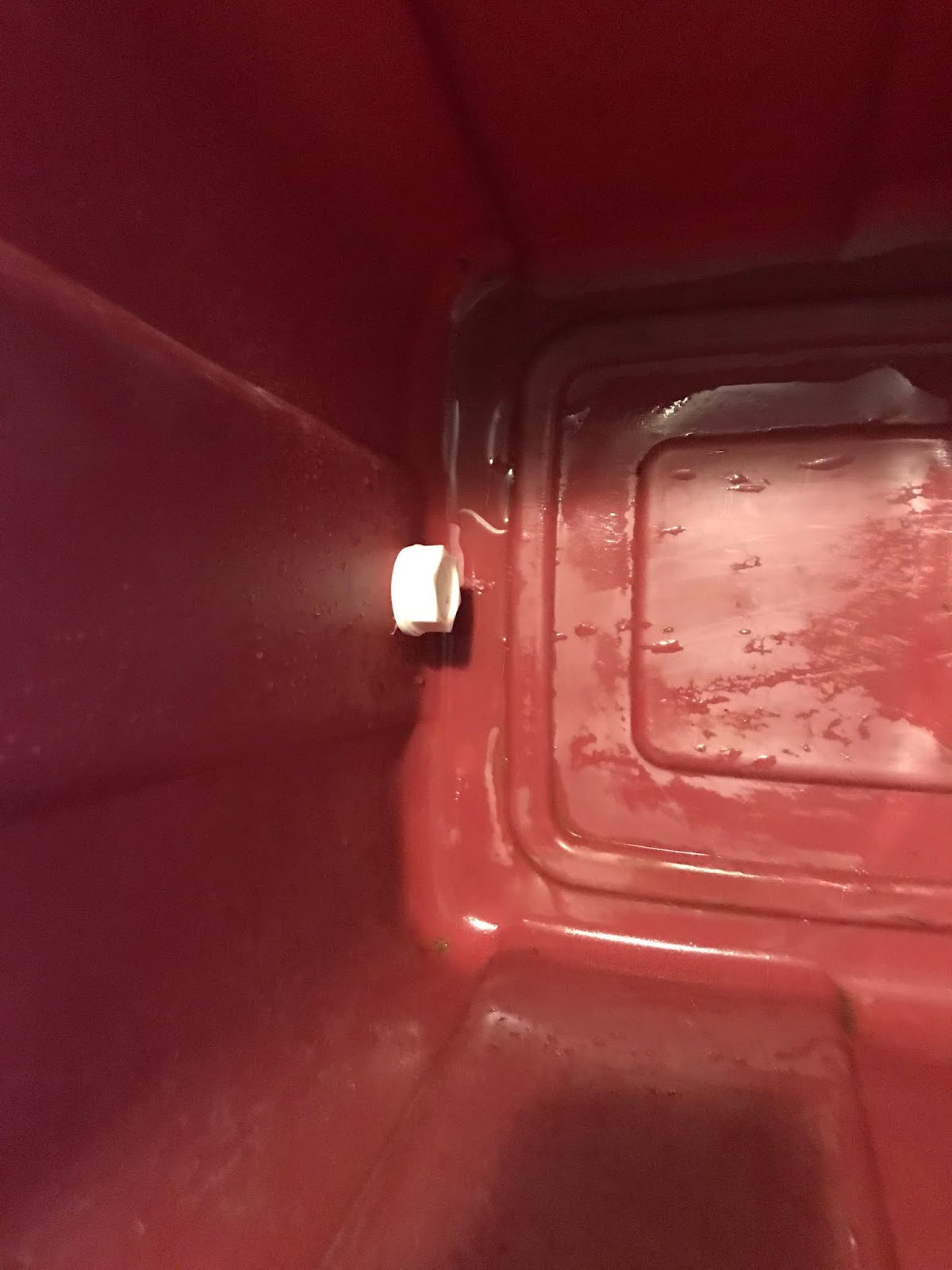
            I drilled a hole near the bottom of one side with a 7/8” spade bit to install a used spigot that I had left over from a scratched-up brew bucket.  If I didn’t have one, I don’t know if I would have purchased one just for this job, but can say that I am looking forward to an easy way to remove liquid from the bin.  My first worm bin had no way to drain, and became heavy with water making it a pain to harvest castings (worm poop) from for use in my garden.  I am not sure if they are made to a universal size, but just checked it against my spade bit to assure it would work with the hole.
A 7/8" Spade Bit easily cuts through the tote


The spigot is threaded and has a nut that holds it in place as well as two rubber washer/gaskets

This will make it much easier to drain off the excess moisture


            Another option to create a draining tote is to drill small holes in the bottom of the tote and then place it over a drip pan.  I will be putting this bin in my office during the cold winter months, and did not want the chance for a mess on my carpet.  Part of the point is to have it someplace where students can come and see what is going on: again, Marston’s belief of educating rural Alaskans on agricultural techniques.  So, the drip pan was not an option for me.
            This is my first time using a spigot in a worm bin, but I figure if I just left the opening uncovered inside that the castings would quickly clog it.  I drilled 11/64” holes through multiple places in a plastic peanut bar jar and then loosely placed the opening of the jar over the opening of the spigot.  My hypothesis is that the water will “filter” through the jar and into the spigot and will keep the spigot opening clear.


            I used the same 11/64” bit to drill a number of holes in the lid of the tote.  I basically used that size because since moving I either don’t have my tools or can’t find them where they have been strategically stored.  This bit just happened to be in the case with the drill.  I wanted to use a small bit that will allow air in but not a lot of light.  Worms are photosensitive and them escaping the tote is not a real concern as they don’t want to be in the light of the room.  If they are stored someplace dark, I guess this would be more of an issue.
            Before adding the worms, I put in some organic material for them to get under and in between.  When I put a bin together in Galena, I used fall leaves as we had them in abundance.  Not so in Unalakleet, and so I am hoping that the grass I pulled up and cut will do the trick.  I threw in some torn up egg carton, coffee grounds in the filter, and a couple of crushed up egg shells for the worms to get started in.
Food for worms
            With the organic material in the bin, I dumped in the worms.  My first batch of worms for my first bin were ordered from Amazon and shipped dried up but still alive.  This is a viable way to start with a large number of worms.  It is kind of expensive though, and so I picked up a container of 30 red wigglers for a little over $3 from the Fairbanks Walmart when I was passing through.  Still Alaskan prices (the worms traveled all the way from Michigan according to the packaging), but cheaper than ordering them on Amazon.

Be fruitful and multiply.  We're starting with 30 and hoping for more.


            I don’t see why night crawlers couldn’t be used instead, and I would like to set up another bin to see which worm is the more efficient  composter, but at this point, I decided to go with the same kind of worm I had used before since I know they work.
            Once the worms are established, it is just a matter of keeping them fed.  No extra water is really needed as the food that is added to the bin supplies enough moisture.  If a bin would be set up in an extremely dry environment, it might make sense to add some water on occasion, but I have found that simply adding green organic material is enough to keep the environment damp enough for the worms.

Things I’ll be adding to my worm bin
Things I won’t be adding to my worm bin
Leaves
Citrus
Grass
Meat
Egg Cartons (shredded)
Fish
Vegetable scraps
White paper
Cardboard (shredded)
Water
Stale Bread and Spent Grains

Coffee Grounds


            Pretty much anything that would go into an outdoor compost pile can go into a worm bin.  The worms will let me know if they don’t like something I put in.  I put in a piece of scrap white copier paper once to try to soak up some extra moisture and created an exodus of worms heading for the exits.
            Though I would add fish to an outdoor pile, fish rotting in a tote in my office is not an appealing idea and would attract flies and other pests.  Same thing with meat.  Citrus, though pleasant smelling, is acidic and not something worms get excited about.  In small amounts, it might be okay.
            If I was worried about how long it took for the worms to finish the compost, I could grind up whatever I was putting in the bin in a blender, but since I am more concerned with ease… I just tear the stuff up by hand or put it in the bin full sized.
            My little worm bin will never make enough vermicompost for me to plant all of my garden in, but it will reduce my dependence upon store bought soil, and if I do use local soil will add a lot of good organic material and nutrients to the garden.  It will also reduce the amount of “good” stuff I send up to the landfill.

            If other people are doing cool stuff to make their own soil or help their gardens grow healthily, I’d love to hear from them.